The Stones We Carry

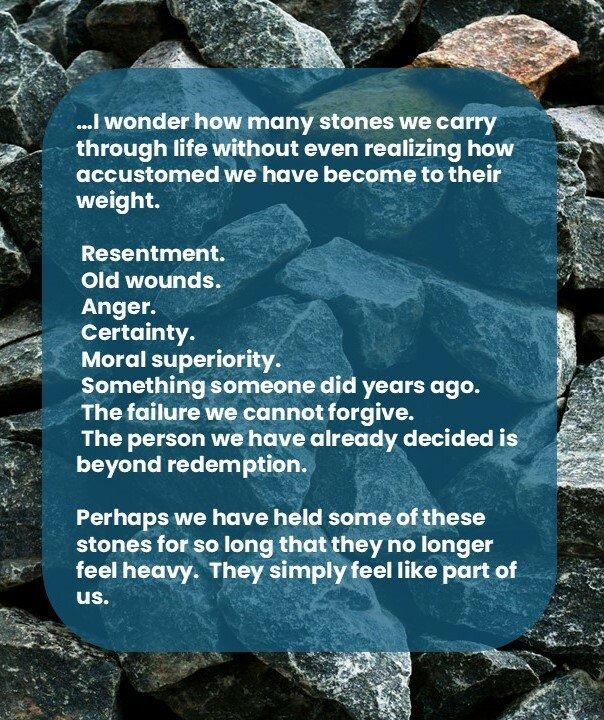
Yesterday in worship, I asked everyone to hold a stone. Nothing particularly special. Just a stone. But if you hold a stone long enough, you begin to notice its weight. A stone, of course, is not necessarily a bad thing. Stones can build houses. They can line gardens, mark graves, become memorials, even become altars.
But a stone can also become a weapon.
Sometimes the difference isn’t the stone. It’s what we’re holding it for.
And I wonder how many stones we carry through life without even realizing how accustomed we have become to their weight.
Resentment.
Old wounds.
Anger.
Certainty.
Moral superiority.
Something someone did years ago.
The failure we cannot forgive.
The person we have already decided is beyond redemption.
Perhaps we have held some of these stones for so long that they no longer feel heavy. They simply feel like part of us.
In 2 Samuel 12, the prophet Nathan approaches King David with a story. A wealthy man with great flocks takes the one beloved lamb belonging to a poor man. David hears the story and immediately becomes furious. He knows exactly what is wrong. He knows exactly who is guilty. He even knows what the man deserves.
Then Nathan says four devastating words:
“You are the man.”
David could see someone else’s sin with remarkable clarity while remaining strangely blind to his own. And maybe that isn’t remarkable at all. Maybe it is simply human.
It is always easier to know what someone else deserves when the stone is comfortably sitting in my hand.
That brings us to John 8. Religious leaders bring before Jesus a woman who has been caught in adultery. They place her before the crowd and begin discussing what should happen to her. There is something disturbing about the scene even before anyone mentions stones. Everybody is talking about her. Nobody is talking to her.
She is brought.
Positioned.
Accused.
Discussed.
Used.
A human being has become a theological problem.
And there is something else wrong with the picture. If she was “caught in the act,” she was not alone. Yet the man is nowhere to be found.
John also tells us that their real concern isn't ultimately the woman. They are testing Jesus.
She has become bait.
So there are really two trials happening at once. The woman is the visible defendant. Jesus is the intended defendant.
And everyone seems to know exactly what someone else deserves.
Then Jesus does something remarkable.
He bends down. And writes in the dirt. Jesus Refuses the Speed of the Crowd
For centuries, people have wondered what Jesus wrote. John never tells us. Maybe the more important thing is not what Jesus wrote but what Jesus refused to do.
They demanded an immediate answer.
Jesus gave them silence.
They demanded outrage.
Jesus gave them space.
They wanted Jesus to react at the speed of the crowd.
Jesus refused their speed.
There is something profoundly important about that for us. We live in a world that constantly demands an immediate reaction.
Social media rewards it.
Politics thrives on it.
Outrage depends upon it.
Someone does something. Someone says something. Someone posts something. And almost immediately we are expected to choose a side, formulate an opinion, and reach for a stone.
Jesus bends down.
Jesus pauses.
Jesus refuses to let the crowd determine the speed of his soul.
Perhaps one of the most Christlike things we can occasionally do is refuse to react at the speed everyone else demands.
Jesus Changes the Question
Eventually Jesus stands and says:
“Let anyone among you who is without sin be the first to throw a stone at her.”
And suddenly the question changes.
Until that moment, everyone has been asking:
What does she deserve?
Jesus asks them to consider:
Who are you as you stand here holding that stone?
It echoes Nathan’s confrontation with David.
“You are the man.”
Nathan turns David’s eyes away from someone else and toward himself. Jesus turns the crowd’s eyes away from the woman and toward themselves. And perhaps the Gospel continually does the same thing to us.
Just when I become completely fascinated with everything that is wrong with them, Jesus quietly asks me to look at what I am holding.
The Stones Our Culture Gives Us
John says the accusers begin leaving one by one.
They arrived as a crowd.
They departed as individuals.
There is something about crowds that makes throwing stones easier. But Jesus' words require each person to make an individual decision:
Am I going to throw mine?
Our culture has plenty of stones available.
Political stones.
Theological stones.
Moral stones.
Denominational stones.
Social-media stones.
And here is the frightening part:
Sometimes our stones contain a piece of truth.
We may actually be correct about what someone has done. We may be correct that something is wrong.
But it is possible to be factually right about what another person has done and spiritually wrong about what we want to do with that truth.
Truth can lead toward restoration. Or truth can become another stone.
Then Jesus Speaks to Her
Eventually everyone else is gone. Only then does Jesus speak directly to the woman.
“Woman, where are they?”
For the first time in the story, she is given a voice. That detail stays with me.
Everyone else has been defining her. Jesus encounters her. We still do this to people.
We turn human beings into categories:
Those people.
Those voters.
Those immigrants.
Those addicts.
Those Christians.
Those liberals.
Those conservatives.
Those people whose beliefs, morality, theology, politics, or way of life trouble us.
It is remarkably easy to talk about categories.
Jesus keeps encountering people.
And after everyone else has disappeared, Jesus tells her:
“Neither do I condemn you. Go your way…”
Go. I love that word. Because it means there is still somewhere for her to go.
Her story isn't finished.
Her worst moment has not become her final identity.
The crowd knew what she had done.
Jesus knew who she still could become.
That is grace.
Grace does not pretend our failures don't matter. Grace simply refuses to believe that our failures are the deepest truth about us.
Beneath everything we have done remains something even more fundamental:
We are God's beloved creation. And God is not finished with us yet.